bruecken_schlag_worte

Brückenschläge und Schlagworte

Autor: bruecken_schlag (Seite 22 von 27)

Tales of Gdańsk – Narracje

narracjeJPGThe last time I went to Gdańsk, I came into town for a Contemporary Art Festival called Narracje that consists of light installations that are projected on walls of different buildings throughout the city. Narracje [English: narrations] is held in Gdańsk for the fourth time, and its motto is the Shakespearian „Art thou gone, beloved ghost?” The website had me so hot for it that I just had to come and see it, and it has been all over my facebook feed, too. Speaking of ghosts, spirits, unearthly relics of the past in a place like Gdańsk and transforming all of this into art – there is basically not a thing about this that I do not like.

We are a group of six when we make our way to the Gdańsk shipyard where a large portion of the installations is set. I am beyond excited, because I have never actually been on the territory of the shipyard – and when we get there, it is so tangibly laden with history. Walking those grounds is like walking along where the Berlin wall used to be. I sense how the entire place is filled with energy, with spirits, how the area tells both of endurance and revolution, of suffering and victory.

We end up on a tour of the installations in the shipyard that is done by the curator of the entire festival, a Canadian of Polish descent named Steven Matijcio. I find his explanations very inspiring. All of a sudden so many of the installations make sense when at first glance they don’t tell me much, even though some of them are unbearably beautiful. I don’t know squat about contemporary art, but Steven combines theories, ideas and notions that I know from literary studies with a material that is strange to me. For every piece, he explains the installation’s immanent meaning first, only to relate it to the building that it is projected on and the entire space that it fills. In some cases, the work of art would be only half as meaningful, had they projected it onto a different wall. We start talking to him about 10 minutes into the tour. One on one his personal passion for all he artwork he is presenting in this festival comes across even more intensely. The day after I go to his tour of the installations in the Old Town, talk to him more, and enjoy it to bits and pieces that I can get all the questions of my chest that come to mind.

There are many, many, many installations that would be worth mentioning. I will just talk about two that I found most moving, but in very different ways.

The first is by Belgian artists Aline Bouvy and John Gillis and is called Venusia. We see it on the first night, projected against Hall 42a’s outside wall in the shipyard. The name of the installation being inspired by Venus, it is obviously a piece about human interaction and relationships. A collage technique filmic installation with powerful, almost sacral music played to it, it is of eerie beauty and intensity with its sudden images of arms trying to reach and lips meeting each other. Prominent to me in it all are the takes of Eyes of different shape and color, all merging into one as though to create the image of one vision for the world, one love, and one mother goddess of all emotion. It is truly aesthetic and as I stand there, I wish I could see the whole 8 minutes, but we don’t have time. I found the installation on the artists‘ website for you though. Click here and scroll down to the very bottom of the page!

20121215-115720.jpg

Past and Present blend into each other at the wall memorial at the Polish Post Office

Angels of Revenge shows close-up film clips of people attired with horror movie props talking about what they would like to do to the person who has wronged them most on their lives. They are not actors, but real people talking about other real people and about real events. Having been cheated on. Having been stabbed in the back for a job or money. All of them adress their tormentor directly – they talk to the camera as though it was the person who has done wrong unto them. In effect, an onlooker of the installation feels like they were addressed. The hatred, the thirst for revenge, at times disappointment, but mostly just blind anger – all of it is hard to take and very disturbing. The things they say are just phantasies – but are they? Very, very bad words are used. The installation is in English with Polish subtitles. I finally start to read and try not to listen, because in English, without any notable language barrier, all the emotion hits me with yet greater force. The entire yard is buzzing with accusation. Connected with the history of the place, it is almost too much for me. I am glad that we cannot linger too long because I might cry. But if art is supposed to tear us out of stupor and make us feel and think and re-evaluate, than this has certainly done it.

20121215-115654.jpg 20121215-115729.jpg

I have not managed to shoot any decent photos with my iPhone. I recommend Algebraiczny for stunning pictures. And I did put the 5th edition of Narracje in my calendar. I will be sure to come to Gdańsk for it next year.

First times and the Magic of Advent

My cousin recently posted a meme on facebook that read

„When was the last time you did something for the first time?“

I had to think fast, and yet I couldn’t really come up with a good answer, and that made me rather sad.

When we are kids, first times present themselves constantly. As we grow older, there are fewer opportunities for them. Partially because we have already done so much, but also because in our daily life and routine, we seek them out far too seldomly. Aside from seeing all the places on my Bucket List (and more) – what about my everyday life? Where’s the new, the unknown? It’s not like there aren’t things I’d like to do for the first time. I have never had absinthe. Or Haggis. Or snails. I have never done kite surfing. Or rock climbing. Or swing dancing. And there is bound to be more. I should really try to keep in mind that every day may grant me the opportunity to do or try something for the first time.

AdventskranzI think that the magic of first times is what we celebrate in Germany when we celebrate Advent. The number of first times, even if just for that specific year, increases dramatically in December.

There is the first of advent (which is today!), the fourth Sunday before Christmas Eve, when the first candle on the advent wreath is lit. The wreath holds four candles, one more will be lit each Sunday until Christmas. Christmas isn’t coming without and advent wreath or fir sprigs that hold all the little decorations I have found in my advent calendar over the years.

AdventskalenderThe advent calendar of course is most exciting, most special on the 1st of December. It consists of 24 little surprises, one for each day between December 1st and 24th. Mine is an embroidered beauty of the 26 letters of the alphabet, all formed by little Santas, surrounded by tiny packages that hold chocolates. It took my mom 6 hours to finish each letter when she handmade the calendar. She really must love me. But then again, for what by now must be 15 years I stand before the filled advent calendar every year on December 1st and am overcome by a childlike excitement and joy, and I know that Christmas is coming, and for some reason, that means that all will be well.

This year, December 1st and first of advent were both in one weekend. And that wasn’t all. This weekend also had the first snow – huge snowflakes in a graceful dance outside my window, covering the yard in a thin sugar coat that makes the grey and dull sight so much prettier. Unfortunately in Berlin, more often than not, snow melts right away. The city’s steaming body gets to it too fast. Still there’s magic in snowfall.

I also went to the Christmas Market for the first time this year and had mulled wine (now it wasn’t the first mulled wine of the season, but mulled wine is just too delicious to wait for it until December every year!). Weihnachtsmarktzauber at Gendarmenmarkt may be the prettiest of Berlin’s more central Christmas Markets. The white tents with the large Moravian stars on top of them are bustling with people of all ages. Some of them sell delicious Christmas Market specific food, like roasted chestnuts and sugar roasted almonds. In others they sell handicrafts, usually very pretty, but really expensive. Christmas Carols are played as well. Lately „Winter Wonderland“ and „Let it snow“ have driven out the more traditional German songs, but let’s face it: You can’t be sure that Christmas is coming until you’ve heard Wham’s „Last Christmas“ on the radio for the *first time* that year anyway, so you may as well make your peace with the fact that English Christmas Carols are saying that the holidays are coming just as much as German ones.

Weihnachtszauber Gendarmenmarkt

Oh Christmas Tree

Even though all these Christmas related things are „first times this year“, not „first times“, they remind me of the beauty of a new start and of the fact that I should treasure *first times* and try to make them happen more frequently.

By the way, I did come up with a very first time after I read my cousin’s meme. I had a dream that was entirely in Polish for the first time when I was last in Gdańsk. The realization of it made me feel giddy and exhilerated. Blessed with the new and unknown, with the excitement of discovery. What a feeling!

SKM-ka, or Gdańsk fast-forwarded

20121220-102554.jpgOne of my most innate Gdańsk adventures lies yet before me. I am going to ride the SKM, a kind of overground metro that connects all of Tricity – that is Gdynia, Sopot and Gdańsk. SKM stands for Szybka Kolej Miejska, fast city train, and wonderfully the Polish have not only made the company name the name for every vehicle that is part of the service, but also personified the abbreviation in the female so each train is called an „SKM-ka“. It is as though in German you would say SKM-in or in Spanish SKM-ita. It adds a whole different dimension of personality to the old, slightly dodgy-looking yellow, blue and white trains. It makes me think of them as old grumpy fat ladies who, while being harsh and cold to everyone, are truly loveable.

20121220-102544.jpgThe 15 minute train ride is uneventful – but it leaves me with time to reflect, like on countless other occasions, on this city. While a long-distance train seems a slow way of transport compared to, say, flying, this SKM-ride makes me feel like everything I connect with the city is rushing by, like someone fast-forwarded my thoughts.

First stop: Gdańsk Stocznia. The shipyards. This is where the Solidarność movement came about, where people went on strike to fight an unjust regime – one of the places where the end of the Cold War began. Another stop: Gdańsk Wrzeszcz. This is where my grandfather was born almost 100 years ago when it was called Danzig-Langfuhr. Yet another stop: Gdańsk Przymorze – Uniwersytet. Przymorze means „by the sea”, I love how the name is so poetic, although the area between Wrzeszcz and Oliwa is actually not exactly pretty but quite industrial. Finally Gdańsk Oliwa, where I get off. This, like Wrzeszcz, is a place that is familiar to me from literary depictions of Gdańsk. Grass’s Tin Drum, Chwin’s Death in Danzig, Huelle’s Who was David Weiser? – all their heroes have walked these streets, like I do now. Maybe my love for Gdańsk partly originates on the pages of books. I wouldn’t be surprised.

And with all these thoughts that revolve around Gdańsk throughout history and in literature, the thing I love the most about this moment is what I’m here for: I’m going to visit a friend. I’m not on a huge mission, not sightseeing or researching. I’m here just to hang out with someone, like any other person in this city might do on a Saturday afternoon. In this moment I’m not a tourist on a journey, I’m not an academic at work. I’m just me in a city that I love.

20121220-102535.jpgWhen I get back to Oliwa’s train station later that afternoon, the electronic board says that the SKM-ka to Gdańsk will be there in 5 minutes. I’m overjoyed with my good timing. Little do I know. I take out my headphones and turn on my music, sitting and waiting for the train, but it doesn’t get in. On the other side of the platform the board says that the train to Wejherowo will be there soon too. When it arrives, I wonder why it is going in the direction that I thought Gdańsk Główny to be in. Well, I must have lost orientaion. A few minutes later the board changes. It now says my SKM-ka will be there in half an hour. Shortly after this, another train going in the other direction is arriving on the platform’s second track. It is only then that I realize that I just let my SKM-ka pass by.

20121220-102522.jpg

SKM station Sopot

And that when I already have a history with this! As I now have half an hour in the cold, there is lots of time to remember at least one previous unfortunate incident with track numbers. A few years ago when I was living in Poland as a volunteer, I needed to go back to my home base in Lower Silesia from Toruń. My friend and I got to the platform, the rusty old board said that our train to Poznań would leave on the left track. We got on, chatting away, but after about 45 minutes we really started to ask ourselves why the train hadn’t left the station yet. After quite a bit of a hassle we found out that this was a regional train, when we should have taken the fast train from the opposite track that had left about 30 minutes ago. Not only did the train we were on leave later, it was also slower, so that we missed our connection in Poznań by way more than an hour. We did catch another train to Wrocław, and my friend made it home to her village by bus. I couldn’t get to my tiny town that day and, bound for a friend’s place, had an odyssey on Wrocław’s city busses to the outskirts of town and got lost in a jungle of the highest socialist concrete skyscrapers i had seen to date in the middle of the night. It all pretty much scared the life out of me and I wasn’t so hot for Wrocław for a while after that.

What do I learn from this about Polish trains of any kind, be it SKM or PKP?

  1. Never trust electronic boards on the platform.
  2. Always check both sides of the platform for your train and if in doubt, when a train is coming, ask a local if it’s yours.
  3. Always bring an extra sweater when you go to Gdańsk in winter. And wear it whenever there is even the slightest chance that you are going to be taking public transport. You may have to wait. And it will be cold. I at least am going back to Berlin with a runny nose.

… and with a smile on my face. Because when it comes down to it, this entire post just makes me realize how German I am and I really enjoy the fact that Poland, however well I may know it already, can still confront me with my own cultural imprint that I will most likely never get rid of.

Bearpit Karaoke – Mauerpark on a Sunday

When I find myself shaken with travel fever and I am really itching to get away, but I’m stuck in the grey, weird, awesome and stressful monstrosity that is Berlin, Bearpit Karaoke at Mauerpark is a remedy that has proven to be helpful every single time for several reasons. I’ll take you on a quick stroll through a Sunday afternoon at the pit to explain to you why that is.

On any given Sunday between sometime in Spring and the last halfway decent day in Autumn, I will get to the pit and there will still be a gymnast, a magician or a stand up comedian heating up the crowd that is bound to be sitting on the steps already. As long as they are still going, I will peform the art of choosing the right place to sit (not too close to the speakers, perfect distance from the stage, preferably in the sun etc.). When around three o’clock the artist of the day will have wrapped it up, Joe Hatchiban arrives with his orange bike that magically transports everything he needs to get the show started – including speakers specifically designed for the pit’s acoustic conditions, wicked!! And the cheering begins. And I cheer, too, for Bearpit Karaoke heals my travel itch, as it is a bit like travelling in itself. And here are the reasons why:

Mariella MauerparkReason #1: It is a place completely out of space and time. If you took this little patch of land and isolated it from its surroundings, there would be no way to tell where you took it from. The language that is spoken most is English with any given accent, and the German accent is not necessarily the most common one in the crowd. I could forget that I am not abroad when I am here. There literally are people present aged 1 through 80 from any country with any background. 


Reason #2: Everyone’s equal in the pit. Because the crowd – I am horrible with estimating numbers, but appearantly there are more than a thousand onlookers on a sunny day – will cheer with equal enthusiasm for someone who is really horrible and for someone who is just rockstar amazing. The people will reward what the performance manages to get across – and even someone who cannot sing can make a thousand people dance, or laugh, or just plain feel something.

CIMG9527Reason #3: When I am there, it is easy to believe that the world is a good place. There is an image that is among my most favorite memories ever. Joe always walks around with a tin collecting donations. The way that everyone stretches out their arms to him is getting to me every time. People are doing it not because they want to take something from him, but because they want to give something to him! There is this immense willingness to give back for all the joy that this event imposes upon everyone who is there. And it looks so beautiful when Joe is jumping up and down stairs and arms are reaching for the tin from every direction to underline the feeling of gratefulness that encircles the pit. Really I am not here to flatter, but Joe is a pretty awesome dude for making this all happen.

Reason #4: Unexpected things happen. A blind Brasilian girl is led to the stage, seeming insecure, and then she’s singing the Scorpions‘ „Rock me like a hurricane“ like an absolute pro. A plain, short, bearded man that in teh street you would easily overlook is coming into the centre and then singing a German version of Sinatra’s „My way“ with so much soul and ernest that you’re just completely taken by him (granted, he is not bearded anymore and also he does this every Sunday, but the first time it is really unexpected! And also, it doesn’t cease to be endearing). Most recently, four people are starting to sing „Gangnam Style“ and all the remains of the pit are storming the stage and starting to dance. There are marriage proposals. Declarations of Love. And just plain old good entertainment.

Reason #5: When I travel, I never have to care about tomorrow – just about the moment. When I am singing for an audience, I feel the same way. Yes, I am a sucker for the stage. I love singing, and I love the funny things that stagefright does to my tummy – especially when there is an audience that I do not know. I find it much harder to perform for people I care about, because I put a lot more pressure on myself. At the pit I go in there and I’m allowed to forget about my ambitions. I just let go and sing. And I return to my seat with adrenalin shooting through my body, and I am feeling alive. There really is no need to be afraid of a performance at the pit. Nothing to lose. Just a whole lot to gain.

As I make my way back to my bike through the park when the show is over, past all the people with their guitars, their drum sets made from cans and boxes, their artwork, their dancing, their hula hooping or whatever else they may have on display, I can’t believe that I am walking on what used to be the death strip. To my left – the former West. To my right – the former East. Today it’s multiculturalism at its best. And a whole lot of happy up for grabs.

Two Germanies

There is a story in the family about me being four years of age and explaining to my mom that there were two Germanies, the Federal Republic and the GDR, and that we were living in the Federal Republic and the people in the GDR were the surpressed ones. Only I didn’t say surpressed, I said squished – easy to confuse „unterdrückt“ and „zerdrückt“ for a little girl.
I do remember the day the wall came down. I was barely five years old. My mom and dad were crying and I had no idea what was going on, but there were lots of people on TV celebrating and appearantly all was well. I asked my mom about that day many many years later and she said that aside from the births of her children, it may just have been the greatest day in her lifetime.
Brandenburg Gate, Berlin, Germany
Another family legend tells of the time between the wall’s downfall and the reunification when my parents took my sisters and me to see Schwerin. My dad, who never spent money lightly, had to change a certain amount of GDR currency that we needed to spend, and there was a fair, and we were allowed to go on rides until we almost threw up. I have a very faint image of a rusty merry-go-round in my head.
I think I speak for most Western German children of the 1980s when I say that we grew up with certain ideas about the GDR, the majority of which were grey, dark and solemn. Also, by the time most of us were old enough to judge for ourselves, we didn’t find that part of German history to be much of an issue. It’s not like it was World War II and we were, as a collective, to be blamed for the deaths of millions of people. It was an unfortunate epoch that now lay behind us. No big deal.
Only when I moved to the former East when I started college did I realize that it was different for other people my age – namely for those who didn’t grow up in the West. They had actual memories of things changing. Their parents had gone through identity crises when the political change came upon them. Everything they knew was re-evaluated – from their breakfast cereal to the educational system that made up their schools and kindergartens.
One friend told me that she was the first year not to become a pioneer anymore. The Thälmann Pioneers were a youth organization in the GDR, in the younger years they were like a scouts movement; the older the children got the more ideological the contents became. The initiation to the pioneers was a big deal and my friend told me that she was heartbroken because she would not get the necktie that belonged with the uniform.
Another friend told me that she was riding the city bus with her mom, and the way she had gotten used to, she started singing, and she sang her favorite song from kindergarten. But right away her mom shushed her and said harshly: „You’re not allowed to sing that anymore!!!“ It was the song about the red Soviet star.
All of a sudden there was room for me to realize that while nothing had ever changed fundamentally in my own life, it was different for my friends. And I keep trying to understand the differences that came about between us with this political event every day.
In Berlin the course of the wall is indicated in the street pavement by the use of different looking paving stones. Every day on my way to work I cross this line on the ground as I go from the former West to the former East. It has become somewhat regular, but on most days I still smile when I do. The idea that it would have been impossible 25 years ago is unspeakable.
Who would I be if Germany had not been reunited 22 years ago today?
I could write a long list of speculations here that I could not possibly prove. I’ll just make one statement that I am fairly certain about: I wouldn’t have been able to leave my heart in so many places. And man, I’d hate that.
German flag, Berlin, Germany

You want to know what Sehnsucht is?

Today after singing class I meandered around my hood for a bit, doing some grocery shopping, having coffee and a delicious piece of rasberry-mascarpone-cake at one of the coffe places that spring up around here like mushrooms as of lately. On my way back home I passed by the church and I figured it was a good time to drop by and give a few words of thanks. And so I did.
Neukölln’s Genezareth church is modern, plain and rather unspectacular. When I do go to church, I still go there because it is close to home. Also, I quite like the community; it is a very colorful and weird mixture that in a group of maybe 30 people attending a service may include anything between young semi-alternative hipsters and disabled homeless people.
So I am there lighting two candles for people who have moved me within the last week and saying a little prayer for them. And then I’m sitting down to think about all that has been happening inside my mind since I came back from Gdansk last Friday. I think about my Places of Desire and about Eastern Europe and how much I am drawn Eastward. I don’t even notice that tears are running down my cheak until a sob is breaking free from my throat. It is ridiculous how I am physically feeling a void inside of me now that I am back in Berlin. Did I mention that finding a new Place of Desire is like falling in love? Well, having to leave it is like being lovesick. I can’t comprehend how three days should have made such a difference, but they have, and I am sitting here feeling like life hasn’t taken me out of Gdansk, but that Gdansk has been ripped out of me. But then again that is not right. Gdansk is a part of me now and it is ever so present. Maybe it would be more fitting to say that the parts of me that have taken on Gdansk fully and completely are stretching out their arms to be reunited with their urban manifestation.
The funny thing about this is that while I am crying, I am not sad. I am nothing but grateful.

How Gdansk became a Sehnsuchtsort

There is no adequate English translation for the German term Sehnsucht. Dictionaries propose „longing“, „yearning“ or „craving“, but those words only actually tell us about the first half of Sehnsucht, the Sehn-part. The second half, Sucht, means „addiction“. Sehnsucht is not only a wish for something that is not present. It is a state that one gets caught up in, a way of existing rather than a way of feeling that is enjoyable and painful all at once and that is hard to fall out of or consciously quit. It may be one of the most intense shades of my emotional range, and in my personal case it is intertwined with curiosity, with a passionate will to learn new things about this world, a constant desire to get to know new places, new people and new things and to understand their past, present and future.
I have a notion in my life that I call Sehnsuchtsorte, places of Sehnsucht, that lacking a better translation I will call Places of Desire for the sake of readability. I refer the term to those places I have come to love on a level that I myself can hardly grasp. It is reserved for the places that have provided me with a sense of coming home to a strange city; the places that have given me beauty beyond belief. Places where I encountered the most amazing people and have learned the most things about the inner workings of this world. They are the places that inexplicably have touched upon a place in my soul that I didn’t know existed, each of them a different one. They are not a rational phenomenon, they are the embodiment of all that love means to me. Places of Desire are what gives me drive and strength, for whenever I think about them I know that if such inner and outer beauty exists, the world can’t be all bad. They are the places that I always miss, in every moment of my life, and in the craving that I have for them lies the seed of my ambitions to make the world a better place. They provide me with my idealism and they remind me of my love for life. They are my most concrete, most tangible, most important ideals. They make me who I am, because they are my home abroad, my Sehnsucht at home. I used to have three of these places: Krakow in Poland, Mostar in Bosnia and Hercegovina, and Istanbul in Turkey. As of now, I have a fourth one. It is called Gdansk.
The flight from Berlin to Gdansk passes but in a heart beat. I am going through my newspaper, folding and re-folding on my narrow plane seat. We have barely risen up when we are already coming down again.For just a moment my eyes slide to the right and out the window, just to check how low we’re going – and the newspaper goes to my lap forgotten, my eyes spellbound on the view. Underneath me I can see the Old Town of Gdansk like a labyrinth of dollhouses, each of which seems to have been painted carefully by hand and set in its rightful place with great care. From its midst, Mariacka’s, that is St Mary’s church’s towers are reaching for the skies, as if they wanted to greet me and bless my visit. The waterways running through the city are dark and go on to open up to the Baltic Sea – a glistening blue mirror of the sky that seems to touch upon eternity. Everything is lit by the soft tones that can come into existence only at dusk, a pastel-colored city, but the red brick stone that I love so much is still the dominant feature of it all. Townhouse upon townhouse with their beautiful rolling gables, there are the city gates, and the shipyards are over there, and way back I can see Westerplatte where World War II started. I have the same feeling of simultaneous fear and awe that I had when I went there by ship last year: the feeling that history in this place is of such density that it is hard to take. I am looking for the monument for the victims of the shipyard strikes in 1970, I cannot find it, my eyes are caught again by Mariacka’s beauty, by the wonderful hanseatic city center that in its style is so familiar to me. The intimacy of this moment between me and Gdansk is almost driving tears to my eyes. It is too pretty to actually be there, an idealized model of a city, unreal and magical; I see things slide by, Długie Pobrzeże, Długi Targ, places I know, places I have been to, places that actually exist down there, right before me, and I’m almost there, I will walk on those cobble stone streets, in this picture book city, my head starts spinning and I am falling, falling into the feeling of Sehnsucht, I am overcome by an addictive desire for this place; and although I’m there already, I am actually longing to be there more, and in this very moment Gdansk has gone from being a town I like to a town I love, it has managed to break through to the height of happy moments in my life, and it has just now, in this moment, acquired the status of being my Place of Desire.
I get off the plane at the airport and I turn west. The sun is setting in the now misty sky. It is pink, not red, but neon dark glowing pink, hot and wonderful, an expression of the passion that has just crept upon me and taken hold of my heart.
Two nights later I am meeting Aga, Karol and Marek for a night out. I met them when I stayed at Happy Seven Hostel last year. We are going up Góra Gradowa hill to the millenial cross. I have never been, and now at night the view offers me new enchanting perspectives of the city. That and the company of three exceptional people are making me giddy, and granted I have had two glasses of wine with dinner, but this is not the effect of that, this is me being drunk on life. How can I put in words the way it makes me feel to be here, in a strange place that is not strange to me at all, with friends who have been showing such  appreciation, such joy at the fact that I am coming to visit? What have I done to be blessed like this? Finding a new Place of Desire is like falling in love. Disbelief. Inexplicable happiness. Overflowing energy and restlessness. Gratitude, first and foremost. For the beauty. For the people. For the privileged life that I am leading. Underneath the stars, at the foot of the cross, I have to take just two seconds to myself to take it all in. And I swear I will try to give something back, one way or another. I don’t know what or how. But my Places of Desire will get me there.

Lahemaa

An meinem Geburtstag wache ich morgens auf, drehe mich im Hostelbett, schlage langsam die Augen auf und mir gegenüber sitzt Wiebke, in der Hand ein Obsttörtchen mit einer brennenden Kerze und grinst mich an. Mich überfällt ein großes Gefühl von Dankbarkeit, Glück und Liebe, für diese Freundin und für alle Menschen, die auf dieser Reise um mich sind. Ich strahle. Im Common Room des Hostels hängt an der Tür ein Zettel, dekoriert mit einer Traube von Luftballons, darauf steht: „Happy birthday, Mariella!“ Ich könnte die ganze Welt umarmen. Man sollte an jedem Morgen Grund haben, sich so zu freuen – und wenn gerade kein Grund in Sichtweite ist, sollte man sich an Dinge erinnern, die einem einen Grund geben. Denn das Leben ist herrlich, heute besonders.
Um 10 müssen wir an der kleinen Touristeninfo sein. Dort wartet bereits eine kleine Menschenmenge, die sich ebenfalls für den Ausflug in den Lahemaa-Nationalpark angemeldet hat. Wir werden in zwei Gruppen zu je acht Personen aufgeteilt und in Minivans verladen. Unser Guide stellt sich vor: „My name is Yevgeniy, but that’s difficult to say for many people, so just call me JJ.“ Jewgenij, denke ich, das klingt aber nicht estnisch. Wenig später sagt er beiläufig, dass es vielleicht interessant sei zu wissen, dass er Russe sei. Einige Fragen kommen daraufhin aus der Gruppe – ob er die estnische Staatsbürgerschaft habe? Natürlich, er habe die russische nicht. Was er von Putins Politik halte? Das habe nichts weiter mit ihm zu tun, schließlich wohne er nicht in Russland und für ihn sei etwa die Politik der Europäischen Union von weitaus größerer Bedeutung als die Russlands. Trotzdem fühlt er sich als Russe. Ich überlege, ob er jetzt ein estnischer Russe ist oder ein russischer Este. Ich frage ihn, ob er zuhause nur Russisch spricht. Ja, aber seine Eltern seien so klug gewesen, ihn auf die estnische Schule zu schicken, so dass er beide Sprachen gleich gut spricht. Ich muss lachen. Mit den seltsamen Vokalen im Estnischen und der Menge an Konsonanten im Russischen, sage ich zu ihm, muss er ja in der Lage sein, fast jeden Laut zu produzieren, den europäische Sprachen so hergeben. Er grinst verlegen.
Die Autofahrt führt uns zuerst durch eine große Plattenbausiedlung mit riesigen grauen Hochhäusern. JJ beschreibt sie als eine Art Russenghetto, und er spricht von den Vorurteilen gegenüber der russischen Minderheit in Estland. Die Kriminalität in dieser Gegend, sagt er, folgt nicht aus der Nationalität, sondern es handelt sich um ein soziales Problem. Die Menschen hier können oft kein Estnisch, sie haben einen niedrigen Bildungsstand, finden keine Arbeit. Ich freue mich sehr, dass wir einmal die russische Perspektive auf die ethnische Spaltung des Landes bekommen. JJ ist sicher nicht der typische Russe, er ist nicht einer von denen, auf denen die Vorurteile basieren, er ist einer, der die Vorurteile zerstreuen kann. Er äußert sich naturgemäß sehr differenziert zu den Belangen der Russen in Estland, und es ist spannend ihm zuzuhören.
Es geht an der Autobahn zum Jägala Juga, dem größten natürlichen Wasserfall Estlands. Es ist Hochsommer, deswegen führt er nicht so viel Wasser und füllt nur die Hälfte der Kalksteinkante. Das sieht lustig aus, ein bisschen abgebrochen.
Wir bleiben hier nur kurz, um anschließend im Nationalpark ein Stück durch den Wald zu spazieren und uns eine alte sowjetische Wasserkraftanlage anzuschauen, die dort unbenutzt vor sich hinmodert. Die schweren Betonplatten sind moosüberzogen, eine Industrieruine am Grunde des tiefen, dichten Waldes und ein eindrucksvolles Denkmal estnischer Geschichte. Hier erzählt JJ auch noch einmal etwas über die Sowjetzeit, und er sagt etwas, von dem ich nicht behaupten kann, dass ich damit uneingeschränkt einverstanden bin, was mich aber dennoch zum Nachdenken bringt: „Hitler was a horrible man, but in my personal opinion, he killed people he thought were his enemies, and he did it in public. Stalin killed his own people, and he did it secretly.“ So einfach ist es natürlich nicht, und Vergleiche soll man sowieso nicht anstellen. Es zeigt vielleicht nur umso eindrücklicher, wie in diesem Teil Europas historisches Leid gewichtet wird.
Der Kontrast zur nächsten Station könnte nicht größer sein. Wir machen Halt an einem der alten deutschen Herrenhäuser in Sagadi. Was Epp gestern über die deutsche Bevölkerung gesagt hat, hier gewinnt es Gestalt: Die Deutschen waren zuhause vielleicht arm, hier waren sie Herren über wunderschöne Anwesen.
Am Eingangstor sind zwei Platten mit Inschriften auf Deutsch in den rosa gestrichenen Stein eingelassen – Bitten für die Altvorderen und für die Nachkommen, aus dem späten 18. Jahrhundert, in altmodischer, feierlicher Sprache. Sie erinnern mich an die Grabinschriften auf Friedhöfen in Niederschlesien – aber hier findet sich deutsches Erbe mal nicht auf einem Friedhof, nicht im Zusammenhang mit Krieg oder Vertreibung oder Unrecht, sondern einigermaßen unschuldig. Oder denke ich das nur, weil ich nicht genug über die Geschichte der Baltendeutschen weiß? Zumindest rühren mich diese Tafeln irgendwie. Wir schreiten in der Gruppe durch den Garten des Anwesens. Wunderschöne Blumen, ein hübscher, etwas verwilderter Gartenteich, und die Sonne wagt sich vorsichtig durch die graue Wolkendecke. Architektonisch bildet die Pracht des Herrenhauses wirklich einen Kontrast zu dem, was ich bisher in Tallinn am eindrucksvollsten fand – den hübschen kleinen Holzvillen in Catherinenthal. Wir schauen uns das Haus nicht von innen an, vermutlich hätte mich das auch völlig aus dem Bewusstsein, in Estland zu sein, herausgerissen.
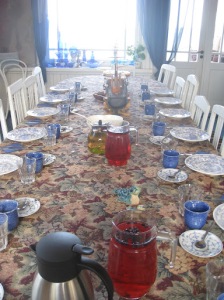
Weiter geht es mit dem Auto über Võsu, eine der größeren Siedlungen im Park mit etwa 500 Einwohnern, nach Käsmu: ein entzückendes kleines Fischerdorf auf der östlichen Seite der gleichnamigen Halbinsel. Hier gibt es im kleinen See-Museum Mittagessen – frischen Lachs mit Pellkartoffeln und einer herrlichen Joghurt-Dill-Sauce. Ich habe vielleicht noch nie so guten Fisch gegessen. Dazu stehen große Karaffen mit Blaubeersaft auf dem Tisch, in dem die Früchte obenauf schwimmen, und zum Nachtisch Butterkuchen. Die Tafel ist entzückend hergerichtet mit blauweißem Porzellan und einer hübschen Tischdecke, und durch das Fenster, das mit blauen Glasflaschen dekoriert ist, hat man einen traumhaften Blick auf die Bucht, die jetzt unter einem strahlend blauen Himmel leuchtet.
Wir bekommen auch eine kleine Führung durch das Museum mit ein bisschen Seemannsgarn und hübschen Anekdoten zur Geschichte der Fischerei in Käsmu. Anschließend schauen wir uns draußen noch um. Ein kleiner Leuchtturm aus Holz schmiegt sich malerisch in die sanften Hügelchen am Ufer, und dann steht da noch ein abgerissener Aussichtsturm. Wiebke und ich klettern hoch. Der Blick ist einfach bezaubernd schön, die Sonne lacht, und ein leichter Wind weht uns um die Nase. Das Meer… Ich kann mir nicht helfen, Berge können mit dem Meer einfach nicht mithalten.
Schon wieder müssen wir in den Van klettern. Bei der nächsten Station habe ich ein bisschen die Orientierung verloren, aber ich vermute, dass wir zwischen Virve und Hara in dem Gebiet sind, dem gegenüber die kleine Hara-Insel liegt, die früher Militärgebiet war. Am Strand tut sich vor uns erneut eine Industriruine auf. JJ erklärt, es handle sich dabei um eine Demagnetisierungsanlage für U-Boote. Es dauert ein bisschen, bis ich das Prinzip verstanden habe. U-Boote können über das Magnetfeld, das sie erzeugen, geortet werden. Die Sowjets haben deshalb ihr U-Boote an diesem Ort mit Hilfe von Elektrizität so präpariert, dass sich das magnetische Feld unter Wasser verändert und sich nicht mehr von dem der Umgebung unterscheidet. Natürlich ist die Anlage inzwischen seit vielen Jahren nutzlos und verfällt ebenso wie die Wasserkraftanlage im Wald. Über Scherben und verrostete, abgebrochene Stahlträger klettern wir auf dem Rest des Gebäudes und auf der Mole herum.
Wir schauen auch einmal kurz in eine der früheren Hallen hinein. JJ weist uns darauf hin, dass sich diese zwei Inschriften auf den Trägern direkt gegenüberstehen:
Raucherbereich
Nicht rauchen!
Über sowas kann ich mich königlich amüsieren. Ich komme wieder mit JJ ins Gespräch. Es geht um die Sowjetzeit, die ich bisher hier im Baltikum ja einhellig aus einer Perspektive geschildert bekam: Als Okkupation, als Zeit der Unterdrückung und des Leids. JJ ist der erste, der, wenn auch vorsichtig, davon Abstand nimmt und sagt, dass er durchaus glaubt, dass nicht alles schlecht war. Seine Großeltern erzählten zum Beispiel durchaus auch von schönen Momenten aus der Estnischen Sozialistischen Sowjetrepublik. Eine Perspektive, die ein „estnischer Este“ sicherlich niemals über die Lippen bringen würde.
Unsere letzte Station ist der Viru-Sumpf am südwestlichen Ende des Parks. Ein Pfad aus Holzplanken führt über den weichen, bemoosten Grund, der fest aussieht, es aber an den meisten Stellen nicht ist. Am hölzernen Aussichtsturm verlässt uns JJ, um uns mit dem Auto auf der anderen Seite des Sumpfes wieder abzuholen. Nach dem Blick vom Turm über die weite Fläche aus Wald, Seen und Moorwiesen ziehen Wiebke und ich auf einem Steg unsere Badesachen an und springen in einen der eisenhaltigen kleinen Teiche mit dem rotorangenen Wasser, das sehr gesund sein soll. Das Wasser ist nicht gerade warm, aber es ist angenehm, und ich ziehe so meine Bahnen und bin gefangen von der Landschaft um mich herum. Die Farben sind von großer Intensität – der Himmel, der gleichzeitig hell und tief ist, die verschiedenen Grüntöne des Sumpfes, und das Wasser, in dem meine Haut eine orangebraune Tönung annimmt.
Wir kommen wieder in Tallinn an, die Stadt wirkt plötzlich laut und urban nach der großen Ruhe in Lahemaa. Im Rathaus gibt es ein kleines Mittelalterrestaurant, wir essen Elchsuppe und Blätterteigpasteten und trinken einen herrlichen Rotwein. Danach ziehen wir noch durch mehrere Cafes und landen schließlich im Kehrwieder am Marktplatz, wo die heiße Schokolade zwar teuer ist, aber dick und sämig wie flüssiger Schokoladenpudding. In meiner geburtstäglichen besinnlich-glücklichen Stimmung sprechen wir über Ziele, über Träume und Pläne. Mir scheint heute alles möglich, alles gut, und ich bin froh, dass Wiebke da ist, um diese Stimmung mit mir zu teilen. Bevor wir ins Hostel zurückkehren, liegen wir noch auf dem Harjuhügel auf einer der Holzliegen und schauen in den Sternenhimmel auf der Suche nach den angekündigten Sternschnuppen. Sie wollen sich uns nicht zeigen, vermutlich ist hier in der Stadt die Lichtverschmutzung zu groß. Es stört mich nicht. Der Tag war so wunderschön, dass er mir wie die Erfüllung eines Wunsches vorkommt, von dem ich nicht wusste, dass ich ihn hatte.

Tallinn II – Stadterkundungen mit dem Fahrrad

Um 16 Uhr geht auf dem Harju-Hügel die Fahrradtour los. Unser Guide ist eine ausgesprochen hübsche Studentin namens Epp. Bevor ich mir auf die Zunge beißen kann, habe ich schon nachgefragt: „As in an iPhone?“ Sie lacht: „Yes, like an iPhone App, only spelled with an E.“ „How often do you hear that question?“ grinse ich. „Only every day. It’s ok. I’m your tourist app for this afternoon, ask me anything.“ Ihr Lachen ist so herzlich und ihre Augen so offen und klar, dass wir uns in ihrer Anwesenheit sofort wohlfühlen. Außer Wiebke und mir ist noch ein sympathischer Neuseeländer, Ian, dabei. Wir schwingen uns auf die Räder und rattern über das altstädtische Kopfsteinpflaster in Richtung Wasser.
Unsere erste Station ist ein Denkmal kaum außerhalb der Stadtmauern, das mich an das Denkmal am Platz der Luftbrücke in Berlin erinnert: Ein abgebrochener großer Bogen. Es soll an die gesunkene MS Estonia erinnern, deren Untergang 1994 das schwerste Schiffsunglück der Nachkriegsgeschichte in Europa markiert. Epp bemerkt, dass fast jeder Este mindestens einen Verunglückten kannte und dass es sich so kurz nach der wiedererlangten Unabhängigkeit nicht besonders angenehm angefühlt hat, dass ein Schiff mit dem Namen des eigenen Landes gesunken war. Ich mag ja eigentlich Symbolik, aber bei solchen Dingen habe ich oft das Gefühl, dass sie übertrieben wird. Immerhin ist Estland ja noch da und schlägt sich, soweit ich das beurteilen kann, ganz gut. Das erste Schiff, das damals zur Rettung eilte und Schiffbrüchige bergen konnte, hieß übrigens wie ich: Mariella.
Wir fahren weiter an einigen ganz klassischen Plattenbauten vorbei. Epp macht wieder Halt und sagt ein paar Sätze dazu. Wiebke und ich nicken wissend; dass die Wohnungen in den Häusern alle gleich geschnitten waren und man sich überall zurecht finden kann, auch wenn man noch nie in genau diesem Gebäude war, das wissen wir – ich aus meiner Greifswalder Zeit und von meinen beruflichen Recherchen, Wiebke deswegen, weil sie gebürtig aus Potsdam kommt. Mir ist das in Berlin auch schon oft aufgefallen, wenn ich Couchsurfer oder Freunde zu Besuch hatte: Man muss alles, was mit Geschichte zu tun hat, sehr zielgruppenorientiert verpacken. Der Neuseeländer hat natürlich zu einer sozialistischen Vergangenheit viel weniger Bezug als wir.
Nun bewegen wir uns langsam aus der Stadt heraus und landen endlich in Kadriorg oder Catherinethal, einem Stadtteil mit wunderschönen kleinen Holzhäusern und grünen Alleen. Zunächst bleiben wir am Wohnhaus von Anton Hansen Tammsaare stehen, einem großen estnischen Realisten und Existenzialisten. Mich kann man mit Schriftstellern natürlich immer ködern, aber Epp spricht so lebendig über sein Leben und sein Werk, dass vermutlich auch ein Bücherwurm Lust bekäme, sein Monumentalwerk „Wahrheit und Gerechtigkeit“ zu lesen. Es hat allerdings fünf Bände.
Nun fahren wir durch einen bezaubernden Park, in dem uns Epp die Grundzüge estnischer Geschichte erklärt. Ich begreife endlich ein bisschen besser, was es mit den deutschen Einflüssen auf sich hat: Überall im Baltikum haben im Mittelalter die Kreuzritter versucht, die heidnischen Stämme zu christianisieren; und da sie zuhause meist schlechter gestellt waren als hier, sind sie geblieben – und auch wenn Estland nie zu einem deutschen Staat gehört hat, waren die Deutschen immer präsent und haben als Baltendeutsche die Kultur mitgeprägt. Die Esten selbst sind dagegen immer Bauern gewesen, und im 19. Jahrhundert, als das nationale Erwachen in ganz Europa um sich griff, begannen auch hier einige kluge Menschen, sich weiterzubilden und für einen estnischen Staat zu streiten. Zu diesem Zeitpunkt gehörte die Region zum Russischen Reich. An den Ersten Weltkrieg schloss sich dann ein Unabhängigkeitskrieg an und 1920 gewann Estland seine Unabhängigkeit und existierte zum ersten Mal als eigenständiger Staat. Dann kamen, wie in den anderen baltischen Staaten auch, die Russen, dann die Deutschen, dann wieder die Russen, und seit 1991 ist Estland da, wo es eigentlich schon vor 150 Jahren sein wollte. Die Geschichte des estnischen Staates ist nicht lang. Die seines Volkes schon.
Wir beobachten den Wachwechsel am Präsidentenpalast. Kaum Zäune, auch keine Besucher, alles sehr verschlafen und hübsch. Wir stehen zu viert da und unterhalten uns darüber, was es für ein lästiger Job sein muss, hier mehrere Stunden zu stehen und sich zu langweilen; und wir sprechen lange über kulturspezifische Vorstellungen von Sicherheit. Undenkbar, das man sich z.B. in den USA so nah vor das Weiße Haus stellen könnte; und in Berlin am Reichstag werden die Sicherheitsvorkehrungen meines Wissens auch immer umfangreicher. Epp erzählt, dass die Enkeltöchter des Präsidenten im Palast mal eine riesige Party gefeiert haben, als der Präsident nicht da war. Der Zugangscode für das Tor hatte vorher per SMS die Runde unter den jungen Leuten in Tallinn gemacht, und die Einrichtung sei hinterher recht ramponiert zurückgelassen worden. Unvorstellbar, aber sympathisch. Sowas passiert schonmal, wenn man Enkeltöchter hat.
Wir sprechen auch über die Preise in Tallinn und über die Krise. Laut Epp hat die Krise in Estland nur mäßig zugeschlagen, es seien sehr früh Gehälter gekürzt und Einsparmaßnahmen gemacht worden. Die Esten beschwerten sich auch über solche Dinge nicht. Nur bei einer Frage seien mal Leute auf die Straße gegangen: Als es um das ACTA ging. Epp sagt: „We are an E-country. You can cut our wages, you can raise the prices, but don’t touch our internet!“ Manchmal muss man eben Prioritäten setzen.
Nun fahren wir ein etwas längeres Stück mit dem Fahrrad zum Song-Festival Gelände. Im Zusammenhang mit dem Nationalen Erwachen entstand das estnische Sängerfest schon im 19. Jahrhundert. Die Anlage ist für die Festivals im heutigen Ausmaß Ende der 1950er Jahre gebaut worden. Alle fünf Jahre singen hier Chöre, gemeinsam kommt der Festivalchor auf bis zu 30.000 Mitglieder. Wir stehen unter der großen Kuppel, Epp spricht nochmals von der Singenden Revolution, von der Bedeutung, die die traditionelle Musik für ihr Land und seine Unabhängigkeit gespielt hat, und ich bin gerührt. Wie wunderbar, wenn sich Menschen durch Musik von Gewaltherrschaft befreien können! Es hört sich natürlich alles sehr romantisch an, und man vergisst die politischen Begebenheiten dabei, aber hier mag ich sie wieder, die große, bewegende Symbolik. An der Seite der Anlage ist eine Plakette, dort steht der Text eines der wichtigsten estnischen Volkslieder, mit dem das Sängerfest traditionell beendet wird. Ian, Wiebke und ich lesen Teile davon vor, Epp muss lachen. Ian hat natürlich die größten Schwierigkeiten, Wiebke und mich, sagt sie, hätte man gut verstehen können. Es hört sich doch sehr skandinavisch an, als sie es nun vorliest, und ist an manchen Stellen dem Deutschen auch sprachverwandt. Epp gibt uns später die Internetseite für Busfahrpläne zur weiteren Planung unserer Reise – sie lautet www.bussireisid.ee, wie niedlich das klingt!
Über den Weg am Rand der Rasenfläche fahren wir auf den Hügel. Von oben sieht die Anlage noch imposanter aus. Ich versuche mir vorzustellen, wie hier alles voller Menschen ist, und wie Musik die klare blaue Sommerluft erfüllt. Es muss unbeschreiblich sein. Eine von den Parkbänken hat Lautsprecher eingebaut – da kommt das Lied, von dem wir eben unten noch sprachen, „Mu isamaa on minu arm“, Mein Vaterland ist meine Liebe. Es hat diese ursprüngliche, getragene Macht und ist wunderschön. Ein Video vom Sängerfest 2004 gibt es hier.
Zum Abschluss geht es noch zum sowjetischen Ehrenmal am Ostseeufer. Die Aussicht hinüber auf das Stadtzentrum über die graublauen Fluten ist weit, offen und herrlich. Der Wind weht, und ich fühle mich aufgehoben in dieser winzigen internationalen Gruppe von liebenswerten Menschen, während mein Blick über die Landschaft schweift. Das Mahnmal selbst ist von jener faschistischen Ästhetik, die man nicht schön finden kann und deren imposantem Eindruck man sich doch nicht entziehen kann. Der Weg zurück in die Stadt führt noch an der Rusalka vorbei, einem Denkmal, das auf fast jeder Ansichtskarte von Tallinn zu sehen ist – Rusalka ist russisch und bedeutet Meerjungfrau, auch diese Statue erinnert an ein Schiffsunglück, aber die Urban Legend behauptet, es handele sich um Lenin mit Flügeln, wie Epp und augenzwinkernd berichtet.  Die Esten haben Humor, das ist nicht zu leugnen.
Unter strahlend blauem Himmel kommen wir wieder am Harju-Hügel an. Wir verabschieden uns voneinander wie alte Freunde. Europa wird immer kleiner, und ich freue mich an dem Gefühl, dass dieses Konzept, dieses Europa, das wir nun seit etwas mehr als 20 Jahren aufbauen und mit dem aufzuwachsen ich das große Glück hatte, uns solche Glücksmomente schenken kann wie diesen Nachmittag.

Tallinn I

Den Übertritt in das dreißigste Land meiner Reisehistorie verschlafe ich, aber auf dem Weg habe ich doch das Gefühl, dass sich die Landschaft verändert. Sie wird noch etwas offener, weiter und grüner. In Tallinn bringt uns ein ausgesprochen netter Taxifahrer zum Hostel – er hat so etwas Verschmitztes, Fröhliches. Vielleicht liegt es daran, dass er uns übers Ohr haut: Die Taxifahrt vier Tage später zurück zum Bahnhof wird für die gleiche Strecke nur die Hälfte des Geldes kosten. Aber das wissen wir noch nicht, als wir bei nordisch-schönem Wetter unsere ersten Eindrücke der estnischen Hauptstadt genießen.
Nach einem kurzen Stopp im minimalistisch ausgestatteten Hostel machen wir einen ersten kurzen Gang in die Innenstadt. Unter einem strahlend blauen Himmel mischen wir uns unter die vielen Menschen. Es ist halb 8 am Abend, aber das Licht wirkt eher wie Spätnachmittag, und die Farbe des Himmels erinnert mich an Dänemark – sie ist von einer besonderen Intensität und einer inneren Kraft. Vor uns tut sich der Marktplatz auf: groß, weit, offen und voller Leben. Ich mag große Freiflächen inmitten einer Stadt, sie lassen mir Luft zum Atmen, zum Erfassen und Verarbeiten.
Die Schönheit der alten Häuser rührt mich an, die vielen Straßencafes und -restaurants sprühen und wuseln darunter im ganzen Glanz des kapitalistischen Konsums. Ich muss den Anblick ein wenig auf mich wirken lassen, bis ich ihn begreifen kann: eine Mischung aus einem dauerhaften Mittelaltermarkt und einer modernen westlichen Großstadt.
Ich bin vorrangig begeistert von der Atmosphäre und dem wunderschönen Stadtbild. Gleichzeitig irritiert es mich, dass vor allen Restaurants Hostessen stehen, die die Passanten abfangen sollen. Es erinnert an die Türkei, nur wird das Anpreisen des eigenen Restaurants hier nicht ganz so aggressiv betrieben. Ich habe diesen Kundenfang auch in Wroclaw und Krakow schon erlebt. Das touristische Gewusel erinnert mich auch an Dubrovnik, wo mich im letzten Jahr die Menschenfülle und die starke Präsenz der englischen Sprache so verärgert hat. Hier stört mich das erstaunlich wenig, und dieser Umstand wundert mich fast ein bisschen. Ich habe vor der Reise schon vermutet, dass mich Tallinn bezaubern wird. Mit manchen Orten geht es mir so, und ich weiß oft nicht genau, woher dieses Gefühl kommt. Überraschenderweise liege ich jedoch meistens richtig. So geht es mir auch hier: Von Anfang an zieht mich Tallinn in seinen Bann, und ich verzeihe der Stadt ihren Kommerz und ihre Touristenfallen. Wir essen zu Abend in einer Seitenstraße des Marktplatzes; Fischsalat und Hummersuppe für teures Geld, aber beides eine absolute Gaumenfreude.
Am nächsten Morgen laufen wir über die Oberstadt wieder ins Zentrum. Wir verlaufen uns kurz zwischen der Newski-Kathedrale und der Treppe in die Unterstadt, werden aber mit einem herrlichen Blick von einem der Aussichtspunkte entschädigt:
Frühstück besorgen wir uns in einer kleinen Delikatessen-Bäckerei, die der Lonely Planet empfiehlt. Wieder ist es erstaunlich teuer, und wir befürchten das schlimmste für unser Budget. Später werden wir lernen, dass Estland seit der Einführung des Euro 2011 eine allgemeine Preissteigerung von 25% erlebt hat. Überdies verdienen viele Tallinner ihr Geld in Helsinki, das nur eine anderthalbstündige Fährfahrt entfernt liegt. Es hilft nicht, sich darüber zu ärgern. Wir verzehren unsere Croissants auf den Stufen an einem der alten Tore in der Stadtmauer in der Sonne, schlendern anschließend ein wenig durch die Stadt und planen die nächsten Tage. Beim Kaffee auf dem Markt stelle ich erschrocken fest, dass meine Kamera nicht da ist. Wiebke und ich teilen uns auf, um die Stationen des Morgens noch einmal abzulaufen. Wir treffen uns wieder, erfolglos. Ich bin mir fast sicher, dass ich die Kamera beim Frühstück auf den Stufen habe liegenlassen, aber dort war sie nicht mehr. Wiebke schlägt vor, noch einmal beim gegenüberliegenden Museum nachzufragen. Ich bin skeptisch und glaube nicht, dass jemand eine gefundene Kamera irgendwo abgibt. Wiebke besteht darauf und zieht noch einmal los, um ihr Glück zu versuchen. Ich warte am Harju-Hügel auf sie. Eine Weile später sagt sie hinter mir meinen Namen. Ich drehe mich um, und sie drückt auf den Auslöser. Tatsächlich ist die Kamera abgegeben worden. Ich bin ein bisschen sprachlos und sehr dankbar.
Es ist spannend mit Wiebke zu reisen. Sie ist in mancherlei Hinsicht doch viel resoluter und auch viel weniger abgeklärt als ich. An anderen Stellen bin ich selbst diejenige, die entspannter und optimistischer denkt. Wir ergänzen uns sehr gut, besonders auch, wenn wir mit Menschen ins Gespräch kommen und Fragen stellen. Wiebke befragt die Leute zur allgemeinen gesellschaftlichen Situation im Land: Kriminalität, Bildungswesen, Emigration. Meine Fragen beziehen sich häufig auf Geschichte, Landessprache und Politik, besonders Minderheitenpolitik. So lernen wir beide viel mehr, als es jede von uns alleine geschafft hätte.
Den Nachmittag verbringen wir in der Sonne auf dem Harju-Hügel.

Die Gegend wurde im Zweiten Weltkrieg von der Roten Armee fast vollständig zerstört. Große Informationstafeln an der unteren Befestigung des Hügels informieren über diesen traurigen Teil der Stadtgeschichte. Russland hat bis in die 1990er Jahre die Bombardierung Tallinns geleugnet und die fast vollständige Zerstörung der Innenstadt den Deutschen angelastet. In der Aufarbeitung wird es so dargestellt, dass die Bombardierung Teil des russischen Plans war, als Befreiungsmacht auftreten und Estland so zum Beitritt zur Sowjetunion zwingen zu können. Der Blick auf die Geschichte ist mir auch hier, wie in Vilnius im Genozidmuseum, etwas zu plakativ. Ich möchte noch besser begreifen, wie die Geschichte hier verlaufen ist, denn im komplizierten Umgang mit der russischen Minderheit in der Region ziehen sich die historischen Fäden eindeutig bis heute fort.

Der Harju-Hügel ist zumindest wieder aufgebaut und als kleine Parkanlage mit einem kleinen Spielplatz und hübschen Holzliegen gestaltet. Wir liegen dort und sind eine Weile nebeneinander jede für sich. Ein junger Vater spielt mit seiner zweijährigen Tochter. Beide sehen blond und nordeuropäisch aus, und der Umgang des jungen Mannes mit dem Kind ist so natürlich und so liebevoll, dass ich die ganze Zeit zuschauen möchte. Die beiden strahlen miteinander eine große Selbstverständlichkeit, fast Alltäglichkeit aus; und gleichzeitig wirkt doch jede Bewegung so, als wäre dieser Augenblick ein ganz besonderer. Es sind diese kleinen Beobachtungen, für die einem das Leben oft nur auf Reisen ausreichend Zeit lässt.Am nächsten Morgen trennen Wiebke und ich uns für ein paar Stunden. Sie geht zu einer kostenlosen Stadtführung mit, die täglich um 12 auf dem Harju-Hügel beginnt. Ich entschließe mich, einmal ein wenig für mich zu sein. Ich muss nachdenken, wirken lassen, schreiben. Ich lege mich in den Hirvepark auf dern frischgemähten Rasen in die Sonne und höre Musik. Etwas abseits erheben sich die Fundamente der Oberstadt, bis zu den Mauertürmen kann man hochgucken.

Tatsächlich habe ich bisher noch nicht viel Zeit gehabt, einfach nur in mich hineinzuhören. Welche Bedürfnisse signalisiert mir mein Körper? Welche Eindrücke haben sich in mein Herz gebrannt? Welche Sehnsüchte haben die Erfahrungen in mir freigesetzt? In Gesellschaft ist es für mich schwerer, diesen Fragen nachzugehen. Ich merke nur in diesem Moment, den Geruch von frischem Gras in der Nase und die strahlende Sommersonne im Gesicht, dass ich mich in Tallinn wohl fühle, ohne dass ich mich anstrengen muss. Zuhause in Berlin verlangt mir die Stadt pausenlose Anstrengungen ab. Hier gibt es Ruhe und Schönheit, und das Reisen bringt die nötige Zwanglosigkeit und Freiheit dazu.
Ich kuschle mich auf meinen Pulli und halte ein paar Gedanken schriftlich fest, Mando Diao schallt aus meinen Kopfhörern. Plötzlich fällt ein Schatten auf mich. Ich erschrecke mich fürchterlich und drehe mich nach allen Seiten, aber ich sehe nicht woher der Schatten kommt. Da spricht jemand mit mir. Ich nehme den Kopfhörer aus den Ohren. „Excuse me?“ sage ich. Ein junger Mann steht neben mir. „I thought you were deed.“ Ich verstehe ihn nicht, habe mich vom Schreck noch nicht erholt und sage etwas unwirsch: „What?“ „Deed,“ wiederholt er und hockt sich hin. „Oh no, I’m not dead, don’t worry, I’m just writing,“ sage ich, und muss nun lachen. Da lächelt auch er. Mit den Worten „OK. Be cool!“ erhebt er sich und setzt seinen Spaziergang fort. Unaufdringlich und höflich, nur besorgt. Die Esten machen bisher einen sehr freundlichen und liebenswerten Eindruck.

An der Stadtmauer entlang wandle ich auf abseitigen Wegen ohne einen jeden Touristen zurück in die Altstadt und treffe mich mit Wiebke. Der Tag hat sehr gut angefangen.

« Ältere Beiträge Neuere Beiträge »